
Cooking with Molluscs
Early man fed extensively on molluscs as evidenced by the enormous heaps of empty
shells that have been found by archaeologists in most parts of the world. Today the
nutritional benefits of seafood as a source of first class protein and essential
vitamins and minerals are well known. Although fish and shellfish are generally low in
fat, the small amount of fat they do contain is beneficial, notably Omega-3 fatty acids
that play a protective role against heart disease.
Very few molluscs are poisonous to eat and there are 7 Classes within the Phylum
MOLLUSCA (Caudofoveata, Solenogastres, Polyplacophora, Gastropoda
Scaphopoda,Bivalvia, Cephalopoda). Species from the 3 major Classes (in bold) are important food items. Within Gastropoda both marine and
terrestrial gastropod species are edible and in eastern Asia seaslugs are considered a
delicacy! Within Bivalvia a wide range of species are eaten: oysters, mussels,
cockles, scallops, and a large range of clams including venerids or carpet clams such
as Venerupis species, Callista chione, Venus verrucosa, razor
clams, soft shell (Mya arenaria) and hard shell or quahog (Mercenaria)
clams, surf clams (Spisula), wedge shells (Donax) to name just a few.
Edible cephalopods consist of cuttlefish, squid and octopus.
Despite the increase in the popularity and availability of molluscs as food, there is
still some mystique in their cookery and edibility. How do we know if the mollusc is
really fresh and are all parts edible? If not which parts are safe to eat? How do we
set about cooking the mollusc to its best advantage? Fortunately there are a numerous
excellent books to answer these questions, some of which include a guide to buying or
collecting molluscs and others give recipes, often with step by step picture guides in
preparation and cooking methods (see Bibliography below).
Water quality is critically important. European waters fall into two Categories:
A. which are the cleanest and from where shellfish can be eaten directly from
the water,
B. where the water has to be purified.
Purification is a process where the water is passed by an ultraviolet lamp which kills
any bacteria. It is therefore evident that care should be taken eating shellfish which
has been collected directly from the sea. Nevertheless there are frequent reports of
people who have become ill after eating shellfish including some who have a persistent
bad reaction. If this is a recurrent consequence it may be sensible to avoid eating
shellfish altogether.
All molluscs deteriorate rapidly once they die so should be eaten raw or certainly cooked when alive. With
bivalves it is essential that they be tightly closed prior to cooking. If some shells
are gaping, you can tap these and if they clamp shut then they are still alive.
Shellfish may need no more than a squeeze of lemon, a drop of Tabasco or a drizzle of
shallot vinegar, and even that might mask the subtle flavour of some molluscs. A pan
of mussels need only be steamed for a few minutes with half a cup of white wine and
some garlic and herbs until the shells open. With nearly all molluscs cooking time is
brief. However squid, cuttlefish and octopus have firmer flesh and may need
tenderising first or long slow cooking. The tentacles and the fleshy body sac are the
only edible parts of cephalopods although the ink sac can be used in cooking, but must
not be ruptured when removed from the body sac. Squid and cuttles are skinned but
octopus are not.
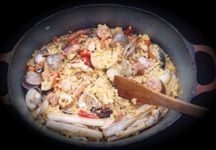
When gathering molluscs from a shore with which you are familiar, and whose water quality you know to be good, you do not need to collect sufficient of one species to convert into a meal. If you have collected a selection of mollusc species ...
... with a bit of ingenuity you can convert these into a highly individual 'Paella' (Click on the image for a recipe)
... or, if you have been lucky enough to find a scallop or two, you can make a luxury breakfast. (Click on the image for a recipe)
Luxury breakfast with scallops
There are numerous fish cookbooks and some dedicated to shellfish. The list below is a small sample. These titles are recommended because they combine recipes with plenty of additional information and illustrations.
Bibliography and Recommended Reading
CADOGAN, M. 1990. A Gourmet's book of Shellfish. Salamander Books Ltd, London.
DAVIDSON, A. 2003. North Atlantic Seafood. Prospect Books, Totnes, Devon. First published in 1979 and in print until the end of the millennium, this revision contains corrections, and changes in scientific nomenclature. It is an excellent compendium which doubles as a cookbook. It lists 34 mollusc species including some which are less well known as foodstuffs e.g. Crepidula fornicata and piddocks.
DAVIDSON, A. & KNOWX, C. 1988. Seafood: A Connoisseur's Guide and Cookbook, Mitchell Beazley Publishers Ltd, London. With a small section at the end giving sample recipes, the body of this book contains descriptions of a range of fish and shellfish (including barnacles and sea urchins) with beautiful illustrations and additional interesting factual information.
GRIGSON, S. & BLACK, W. 1998. Fish. Headline Book Publishing, London. Although covering the whole spectrum of fish cookery, this book has a good chapter on shellfish with particular emphasis on bivalves. The authors describe provenances, cultivation and harvesting practices, and intriguing anecdotal information on the use of molluscs in diet.
LOVELL, M.R. 1884. The Edible Mollusca of Great Britain and Ireland with recipes for cooking them. L. Reeve & Co., London. A classic work which is an authoritative source of historical information on the culture of molluscs in diet.
MITCHAM, H. 1975.Provincetown Seafood Cookbook. Addison-Wesley Publishing Company Inc. "A delightful collection of reliable recipes, folk history and local color by Cape Cod's best-known and most admired chef". Just one example of the quirky works that is much more than a cookbook.
STEIN, R. 1995. Taste of the Sea. BBC Books. Preparation methods for cooking molluscs.
STEIN, R. 1997. Fruits of the Sea. BBC Books. More information on preparation methods including illustrations of techniques used.


