
Access glossary of gastropod terms
Diagram of parts of the bivalve shell and glossary of terms.
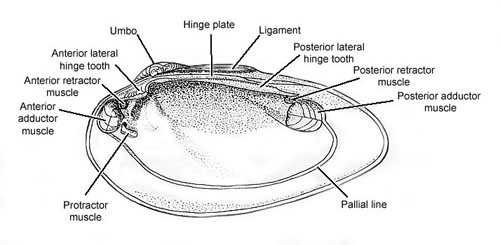
Use the text links below to see relevant diagrams
- ADDUCTOR MUSCLE.
- Muscle connecting the two valves of the shell and tending to draw them together. There are normally two adductor muscles in each animal.
- ADDUCTOR MUSCLE SCAR.
- Impression on the interior of the shell where the adductor muscle was attached.
- ALATE.
- With wings or auricles.
- ANISOMYARIAN.
- Shell with the anterior adductor muscle much reduced or absent.
- ANTERIOR.
- Direction parallel to the cardinal axis approximating to that in which the mouth of the animal faces; front.
- ANTERIOR LATERAL TOOTH.
- Lateral tooth situated in front of the beaks.
- ANTERIODORSAL MARGIN.
- Edge of the dorsal part of the shell which is in front of the beaks.
- APOPHYSIS (singular) -ES (plural).
- A finger-like projection from beneath the umbones on the inside of some bivalve shells, to which the foot muscles are attached in some Pholadacea.
- AURICLE.
- Earlike extension of the dorsal part of the shell, commonly separated from the body of the shell by a notch or sinus.
- AURICULAR CRURA (singular:CRUS).
- Blunt internal ridges, swelling out distally as low tubercles, marking the lower border of the ears in some Pectinidae.
- AURICULAR SULCUS.
- External furrow at junction of ear with the body of the shell.
- AURICULATE.
- With ears.
- BASAL MARGIN.
- Edge of shell opposite to hinge, i.e. ventral margin.
- BEAD.
- Small, rounded protuberance on rib.
- BEAK.
- In bivalves, the tip of each valve, the oldest part of the shell, generally pointed and near the hinge.
- BYSSAL FORAMEN.
- Opening, in the right valve of Anomiidae, for the passage of calcified byssus.
- BYSSUS.
- A bundle of fibres laid down by the foot of some bivalves, and used by them for attachment; The gape through which it passes is sometimes called the byssal notch or byssal gape.
- CALLUM.
- Part of bivalve shell, laid down in the adult of a few species of the Pholadidae as an extension of the shell proper to cover the gape between the valves.
- CARDINAL AREA.
- Flat or slightly concave, commonly triangular surface extending between the beak and hinge margin in some bivalves, and wholly or partly occupied by the ligament.
- CARDINAL AXIS.
- Imaginary straight line along which the two valves of the shell are hinged.
- CARDINAL PLATFORM.
- See HINGE PLATE.
- CARDINAL TOOTH.
- Hinge tooth situated close to the beak.
- CAUDATE.
- With a narrow, tail-like extremity.
- CHANNEL.
- Widely grooved.
- CHONDROPHORE.
- The pit (which may or may not project) to which the internal ligament is attached.
- CLOSED.
- Not gaping anywhere along the shell margins.
- COMMISURE.
- Line of the junction of the two valves.
- CONDYLE.
- The rounded shoulder or knob on which the valves move or rock in some species of bivalves.
- COSTELLA.
- Rather narrow linear elevation of shell surface.
- CRENULATE.
- Used to describe the notched edge of the margin in some bivalve shells.
- CRISPATE.
- With crinkled edge or margin.
- CRUCIFORM MUSCLE SCARS.
- Two small scars left by muscles which are used in the Tellinacea and some Solenidae joining valves posterioventrally and intersecting to form a cross, which are situated below the pallial sinus.
- CTENOLIUM.
- Comblike row of small teeth on lower side of byssal notch in some Pectinacea.
- CUNIFORM.
- Wedge shaped.
- DECUSSATE.
- Ornament consisting of two sets of oblique ridges that cross to form a series of 'X's.'
- DENTICLE.
- Small rounded toothlike protuberance.
- DENTITION.
- Hinge teeth and sockets, considered collectively.
- DIAGENODONT.
- With differentiated cardinal and lateral teeth located on the hinge plate, laterals not exceeding two or cardinals three in either valve (e.g. Astarte).
- DIMYARIAN.
- Having two adductor muscle scars in each valve.
- DISC.
- In Pectinacea, the whole of the valve except the auricles.
- DISSOCONCH.
- Postlarval shell.
- DIVARICATE.
- Ornament composed of pairs of widely divergent costae.
- DORSAL.
- Back; region of shell where the valves are connected by the ligament.
- DYSODONT.
- With small, weak teeth close to beaks.
- EAR (AURICLE).
- Small extension of dorsal region of shell, commonly separated from the body of the shell by a notch or sinus.
- EDENTULOUS.
- The condition when teeth are absent from the hinge line in bivalves.
- EMARGINATE.
- Margin notched or variously excavated.
- ENSIFORM.
- Shaped like the genus Ensis, like a curved sword or old-fashioned cut-throat razor.
- ENTIRE.
- Pallial line lacking a sinus.
- EPIDERMIS.
- See PERIOSTRACUM.
- EQUILATERAL.
- The condition when the growth of the shell of a bivalve on either side of the beaks is almost symmetrical.
- EQUIVALVE.
- The condition when both valves are similar in shape, size,sculpture, etc.
- ESCUTCHEON.
- A depressed area in some bivalves, behind the beaks in one or both valves, set off from the rest of the shell by a change in colour or sculpture, and sometimes bordered by a ridge.
- EXCURRENT.
- See EXHALENT.
- EXHALENT.
- Mantle opening or siphon where water is expelled form the mantle cavity.
- FALCIFORM.
- Sickle shaped.
- FASCICLE.
- Arranged in bunches.
- FIBROUS LIGAMENT.
- Part of the ligament characterised by a fibrous structure and in which the conchiolin has been impregnated with calcium carbonate.
- FLABELLIFORM.
- Fan shaped.
- FLAMMULES.
- Flame shaped patches of colour.
- FLUTED.
- A series of narrow parallel rounded excavations, like the fluting of a column.
- GAPE.
- The space left between the valves when the adductor muscles are fully contracted.
- GILL RETRACTOR MUSCLE.
- Muscle present in a few bivalves attaching one of the gills to the shell.
- GLOBOSE.
- Tending towards a spherical shape.
- GRANULATED.
- Covered by small grains or tubercles.
- GROWTH LINES.
- Lines on the surface of the shell marking the position of the margin at some stage of growth.
- GROWTH RUGAE.
- Irregular wrinkle on the surface of the shell of similar origin to growth lines but corresponding to a more pronounced hiatus in growth.
- GROWTH STAGES.
- Approximately concentric lines around the beaks indicating cessation of growth (often annually) superimposed upon the general sculpturing.
- HEIGHT.
- Distance between two planes parallel to the cardinal axis and perpendicular to the plane of commisure, which just touch the most dorsal and most ventral parts of the shell.
- HETERODONT.
- With distinctly differentiated cardinal and lateral teeth.
- HETEROMYARIAN.
- With one adductor muscle (anterior) much reduced.
- HINGE.
- Collective term for structures of the dorsal region which function during opening and closing of the valves.
- HINGE AXIS.
- See HINGE LINE.
- HINGE LINE.
- Imaginary straight line about which the two valves are hinged.
- HINGE PLATE.
- Shelly internal platform bearing hinge teeth, situated below beak and adjacent parts of the dorsal margin, and lying in the plane parallel to that of the commisure.
- HINGE TOOTH.
- Shelly structure (usually one of a series) adjacent to the dorsal margin and received into a socket in the opposite valve. Hinge teeth serve to hold valves in position when closed.
- HOMOMYARIAN.
- With two adductor muscles equal in size, or almost so.
- HYOTE SPINE.
- Hollow, tubular and cylindrical shell outgrowth, open distally at their tip as well as on their distal flank.
- HYPOPLAX.
- One of the accessory plates found in the Pholadidae. It is single and sits across the ventral gape between the valves in the posterior half.
- IMBRICATE.
- Overlapping like tiles or shingles on a roof.
- INCURRENT.
- Mantle forming a passage for the current of water drawn into the mantle cavity from outside water.
- INEQUILATERAL.
- With parts of the shell anterior and posterior to the beaks differing appreciably in length.
- INEQUIVALVE.
- With one valve larger than the other.
- INFLATED.
- Strongly convex.
- INHALENT.
- See INCURRENT.
- INTERSPACE.
- Depression between adjacent costae or other linear surface equivalents.
- INTERVAL.
- Same as INTERSPACE.
- ISOMYARIAN.
- With two adductor muscles equal in size, or almost so.
- LAMELLAR LIGAMENT.
- Part of ligament characterised by its lamellar (layered) structure and containing no calcium carbonate.
- LATERAL TOOTH.
- Hinge tooth in front of or behind the cardinal teeth and located some distance from the beaks.
- LEFT VALVE.
- The valve on the left hand side when the shell is placed with the pallial sinus towards the observer, and the beaks uppermost.
- LENGTH.
- Distance between two planes perpendicular to the cardinal axis and just touching the anterior and posterior extremities of the shell.
- LIGAMENT.
- Horny elastic stucture or structures, joining the two valves of the shell dorsally and acting as a spring, causing the valves to open when the adductor muscles relax.
- LIGAMENT PIT.
- Relatively broad depression in the cardinal area for the attachment of the ligament.
- LITHODESMA.
- A calcareous structure which supports the internal ligament in a few species of bivalve.
- LONGITUDINAL.
- Direction parallel to that of the cardinal axis.
- LUNULE.
- A depressed area present in some bivalves, situated in front of the beaks, in one or both valves, generally set off from the rest of the shell by a change in sculpture or colour.
- MACULATE.
- Splashed, spotted or blotched.
- MANTLE.
- Fleshy or membranous outgrowth of the body wall which secretes the shell.
- MESOCONCH.
- Part of dissoconch formed at an intermediate stage of growth, and separated from earlier and later formed growth by pronounced discontinuities.
- MESOPLAX.
- One of the accessory plates found in the Pholadidae, either paired or single; it sits across the umbones.
- METAPLAX.
- One of the accessory plates found in the Pholadidae; it is single, dorsal in position, behind the umbones.
- MONOMYARIAN.
- Having a single adductor muscle in each valve (the posterior).
- MUSCLE SCAR.
- Impression on the interior of the shell marking the former place of attachment of a muscle.
- MYTILIFORM.
- Shaped like Mytilus (the common mussel).
- MYOPHORE.
- The same as apophysis, i.e. a finger-like projection from beneath the umbones on the inside of some bivalve shells, to which the foot muscles are attached in some Pholadacea.
- NACREOUS.
- Type of shell structure consisting of thin leaves of aragonite parallel to the inner surface of the shell and exhibiting its characteristic lustre; pearly.
- NEPIOCONCH.
- Earliest formed part of the dissoconch, when separated from the later part by a pronounced discontinuity.
- NEPIONIC.
- Earliest post-larval stage.
- NODOSE.
- With small, knoblike protuberences.
- NYMPH.
- A ridge or platform set into the hinge line of some bivalve species and situated above the teeth and behind the beaks, to which the external ligament is attached.
- OPISTHOCLINE.
- Sloping (from the lower end) in the posterior direction – term applied to hinge teeth.
- OPISTHOGYRATE.
- Curved so that the beaks point in a posterior direction – term applied to umbones.
- ORBICULAR.
- Circular.
- ORNAMENT.
- Relief pattern on the surface of many shells.
- ORTHOCLINE.
- Perpendicular to the hinge axis or almost so – term applied to hinge teeth and, in some genera, to the body of the shell.
- ORTHODONT.
- Type of hinge in which the direction of the teeth is parallel to the cardinal margin, or nearly so.
- ORTHOGYRATE.
- Curved so that each beak points neither anteriorly nor posteriorly, but directly towards the other valve.
- OSTRACUM.
- The calcareous part of the shell beneath the periostracum.
- PACHYDONT.
- With heavy, blunt amorphous teeth
- PALLETS.
- Paired calcareous structures at the posterior end of the animal in the Teredinidae which can be pushed into the open end of the wood burrow to close it; pallets may be simple or compound.
- PALLIAL.
- Pertaining to the mantle.
- PALLIAL LINE.
- The mark on the inside of a bivalve shell left at the position of the attachment of the mantle lobes; normally concentric with the ventral margin, it connects the anterior and the posterior adductor scars and may be indented by a sinus: exceptionally it is made up of a series of separated muscle scars.
- PALLIAL RETRACTOR MUSCLES.
- Muscles for withdrawing the marginal parts of the mantle into the shell where there is no distinct line of muscle attachment.
- PALLIAL SINUS.
- An indentation in the pallial line, sometimes pronounced, aways with its opening in the posterior half of the shell and sometimes with its lower margin confluent with part of the pallial line.
- PEDAL ELEVATOR MUSCLE.
- Thin bundle of muscle fibres attacahed to the shell in the umbonal cavity and serving to raise the foot.
- PEDAL GAPE.
- An opening between the margins of the shell for the protrusion of the foot.
- PERIOSTRACUM.
- Horny organic coat covering the calcareous inner shell or ostracum.
- POSTERIOR.
- Direction approximating that in which the anus, faeces and exhalent current is discharged; the pallial sinus is posterior.
- POSTERIOR LATERAL TOOTH.
- Lateral tooth situated posteriorly to the beaks and, in heterodonts, posteriorly to the ligament.
- POSTERIOR RIDGE.
- Ridge passing over or originating near the umbo and running diagonally towards the posteroventral part of the shell.
- POSTERIOR SLOPE.
- Sector of surface of valve running posteroventally from the umbo.
- POSTERODORSAL MARGIN.
- Margin of dorsal part of shell posterior to the beaks.
- PRIMARY RIB.
- On a shell with different orders of strength, the rib that appears early in life and remains stronger than those appearing later.
- PRISMATIC.
- Shell structure consisting of prisms of calcite or aragonite.
- PRODISSOCONCH.
- The shell secreted by the larva or embryo and preserved at the beak of some adult shells, often as a small, smooth area.
- PROSOCLINE.
- Sloping (from the lower end) in an anterior direction – term applied to hinge teeth.
- PROSODETIC.
- Located anterior to the beaks.
- PROSOGYRATE.
- Curved so that the beaks point in an anterior direction – term applied to umbones.
- PROTOPLAX.
- Flat spearhead-like accessory plate, in one piece or divided longitudinally into two, situated at the anterior end of the dorsal margin of some Pholadidae.
- PROTRACTOR MUSCLE SCAR.
- Insertion point of a muscle situated below the adductor muscle and attached to the foot.
- PUNCTATE.
- With pinprick-like depressions.
- PYRIFORM.
- Pear shaped.
- QUADRATE.
- Square, or nearly so.
- RADIAL.
- Direction of growth outward from the beak at any point on the surface of the shell.
- RESILIFER.
- Recess or process for attachment of an internal ligament.
- RESILIUM.
- Internal ligament, regardless of composition.
- RETICULATE.
- Forming a network of obliquely intersecting sculptural elements.
- RETRACTOR MUSCLE SCAR.
- Insertion point of a muscle situated above the adductor muscle and attached to the foot.
- RHOMBOIDAL.
- Shaped like a rhombus – a parallelogram with oblique angles and sides of equal length.
- RIB.
- Projecting ridge on shell, usually transverse (on external surface unless otherwise indicated).
- SAGITTAL PLANE.
- Antero-posteriorly directed plane of symmetry of the shell and soft parts.
- SCHIZODONT.
- With one tooth, median of left valve, broad and bifid.
- SCULPTURE.
- Relief pattern on shell surface.
- SIPHON.
- Tubelike extension of the mantle for passage of inhalent or exhalent current.
- SIPHONOPLAX.
- Tubular secondary structure forming posterior extension of the shell in some Pholadidae, and protecting the proximal end of the siphons.
- SOCKET.
- Recess for reception of the hinge teeth of the opposite valve.
- SPIROGYRATE.
- Coiled outward from the sagittal plane – term applied to umbones.
- SQUAMOSE.
- With scales.
- STRIA (Plural STRIAE).
- Fine incised groove on shell surface.
- SULCUS.
- Radial depression of the surface of the shell.
- TAXODONT.
- The condition when numerous alternating small teeth and sockets occur along the hinge of a bivalve shell, some or all transverse to the hinge margin.
- TEETH.
- Projections from the hinge of a bivalve shell. See also cardinal teeth and lateral teeth.
- TELODONT.
- With differentiated cardinal and lateral teeth, e.g. Venus.
- TENSILIUM.
- External ligament.
- THREAD.
- Fine linear surface elevation.
- TRANSVERSE.
- Direction perpendicular to the cardinal axis in the plane of the valve margin.
- TRAPEZIFORM.(U.K.)
- With four straight sides only two of which are parallel.
- TRAPEZOIDAL. (North American)
- With four straight sides none of which are parallel.
- TRIGONAL.
- Three sided.
- TUMID.
- Swollen or inflated in shape.
- UMBO (singular) -ONES (plural).
- Region of the valve surrounding the point of maximum curvature of the longitudinal dorsal profile and extending to the beak when not coinciding to it; normally convex.
- UMBONAL ANGLE.
- In Pectinid shells the angle of divergence of umbonal folds. In other shells the approximate angle of divergence of postero-dorsal and antero-dorsal parts of the longitudinal profile.
- UMBONAL CAVITY.
- Part of the interior of the valve that lies within the umbo and under the hinge plate if present.
- UMBONAL FOLD.
- In Pectinid shells, the ridge originating at the umbo and setting off the body of the shell from the auricle.
- UMBONAL REFLECTION.
- The condition found in some Pholadacea when the dorsal line is turned back in front of and over the umbo in each valve; the anterior adductor muscle is attached to the umbonal reflection.
- VALVE.
- One of the calcareous structures of which the shell consists.
- VELICONCH.
- Shell borne by veliger larve; identical with prodissoconch when larva is pelagic.
- VENTRAL.
- Pertaining to or located near to the region of the shell opposite to the hinge, where the valves open most widely.
- VENTRICOSE.
- Strongly inflated.
- WING.
- More or less elongate, triangular, distally acute or obtuse, terminal part of dorsal region of shell in Pteriacea, Pectinacea, etc.
- XENOMORPHISM.
- Special sculpture at umbonal region of the unattached valve resembling the configuration of the substratum onto which the attached valve is or was originally fixed. Known in Anomidae, Ostreidae, etc.
SOURCES OF TEXT:
Moore, R.C. (ed.), 1960. Treatise on Invertebrate Palaentology. Part I, part 1. Lawrence, Kansas, Kansas University Press and Geological Society of America. pp. 126-135.
Moore, R.C. (ed.), 1960. Treatise on Invertebrate Palaentology. Part N, part 1. Lawrence, Kansas, Kansas University Press and Geological Society of America. pp. 102-109.
Pain, T. (?1960). A short glossary of molluscan terms. London, Conchological Society of Great Britain and Ireland. Papers for Students, no. 4.
Tebble, N., 1976. British bivalve seashells: a handbook for identification. 2nd. edition. Edinburgh, HMSO.
Return to glossary of bivalve terms
Diagrams of parts of gastropod shell and glossary of terms
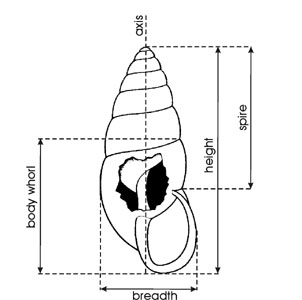
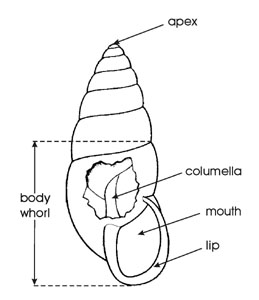
- ABAPICAL.
- Away from the shell apex toward the base, along the axis or slightly oblique to it.
- ABAXIAL.
- Outward, away from the shell axis.
- ACICULATE.
- Needle shaped.
- ACULIATE.
- Very sharply pointed; prickly.
- ADAPICAL.
- Toward the shell apex along the axis or slightly oblique to it.
- ADAXIAL.
- Inward toward the shell axis.
- ADNATE.
- Growing together, connected.
- ANNULAR.
- Made up of rings.
- APERTURE (or MOUTH).
- The opening of the shell of a gastropod, providing the outlet for the soft parts of the animal.
- APEX.
- First-formed end of a gastropod shell, usually the extreme point of the shell.
- APICAL ANGLE.
- In the plane through the axis, the angle subtended between two straight lines that touch adjacent whorls on opposite sides near the apex; identical with the spire angle if the whorls increase at a regular rate.
- AXIAL.
- Parallel with the shell axis.
- AXIS.
- Imaginary line vertically through the apex, around which the whorls are coiled.
- BASAL CREST.
- External angulation at base of body whorl in the shell of some gastropods.
- BODY WHORL.
- Last-formed, complete coil of shell of gastropods.
- CALLUS.
- Smooth interior lining of pale shelly material, frequently obvious within the mouth of a gastropod, e.g., as a coating on the parietal area.
- CANAL.
- Narrow, subtubular extension of the aperture cf. 'SIPHONAL CANAL'.
- CANCELLATE.
- Having an ornament of intersecting spiral and transverse threads or cords.
- CARINA.
- Prominent spiral ridge or keel.
- CARINATE.
- Bearing a keel (carina).
- CHANNELLED.
- Sharply sunken below the general surface (e.g., a channelled suture)
- CLAUSILIUM.
- Spoon-shaped flexible plate which functions as an operculum in the family Clausiliidae.
- COELOCONOID.
- Approaching conical, but with concave sides.
- COLUMELLA.
- Solid or hollow pillar surrounding the axis in coiled gastropod shells, formed by the inner walls of the whorls.
- COLUMELLAR.
- Referring to that part of the interior surface of the shell, comprising the columella.
- COLUMELLAR FOLD.
- Spirally wound ridge on the columella that projects into the shell interior.
- COLUMELLAR LIP.
- Adaxial part of the inner lip comprising the visible terminal part of the columella.
- CONCENTRIC.
- With direction coinciding with that of the growth lines.
- CONCHIOLIN.
- Protein of which the periostacum and organic matrix of the calcareous parts of the shell are composed.
- CONISPIRAL.
- With spire projecting as a cone or conoid.
- CONVOLUTE.
- With the last whorl completely embracing and concealing the earlier ones.
- CORD.
- Round topped, moderately coarse spiral or transverse linear elevation on the shell surface.
- CORONATE.
- Bearing tubercles or nodes at the shoulder of the whorls.
- COSTA (Plural: COSTAE).
- Round topped elevation of moderate width and prominence (greater than a cord) on the shell surface, parallel to the outer lip.
- COSTATE.
- Having costae.
- CRENATE.
- With notches along an edge, rib or the lip.
- CRISPATE.
- With a crinkled edge or margin.
- CUNIFORM.
- Wedge shaped.
- CYRTOCONOID.
- Approaching a cone in shape, but with convex sides.
- DECOLLATE.
- Apical whorls missing, eroded or discarded.
- DENTICLE.
- Small round or oval "tooth" on the interior surface of some gastropod shells, often on or just within the mouth edge.
- DEXTRAL.
- The right-handed coiling of some gastropods; when the mouth is on the observer's right and the apex is directed upwards, and with the mouth facing the observer. (cf. SINISTRAL)
- DIAMETER.
- The distance between two planes parallel with each other and with the shell axis, which touch opposite sides of the shell.
- DIGITATION.
- Fingerlike outward projection from the outer lip.
- DISCOIDAL.
- Approaching a disc in form; axially compressed.
- DISTAL.
- Away from the central axis or from the apex.
- EDENTULOUS.
- Lacking teeth.
- ELEVATED.
- High in proportion to the diameter.
- EPIPHRAGM.
- Dry mucus sheet, temporarily used to close the mouth of some gastropods. In some large snails it may be thickened with lime and consequently opaque.
- FIMBRIATE.
- Puckered.
- FOLD.
- Spiral ridge on interior of shell wall.
- FORAMEN.
- An opening or hole.
- FULVOUS.
- Orange in colour.
- FUSIFORM.
- Slender, spindle-shaped, tapering almost equally towards both ends from a maximum diameter (e.g. the shell shape of Clausiliidae).
- GIBBOUS.
- Very convex or tumid. (Also GIBBUS).
- GRANULATED.
- Covered with small grains or tubercles.
- GROWTH-LINES.
- In gastropods, surface markings left in the former positions of the mouth-edge.
- HELICONE.
- Coiled tube that forms most gastropod shells, which expands as it grows.< /dd>
- HETEROSTROPHIC.
- Condition of the protoconch when the whorls appear to be coiled in the opposite direction to those of the teleconch.
- HIRSUTE.
- Hairy.
- HOLOTYPE.
- The single specimen on which the description of the species is based.
- HYALINE.
- Glossy, transparent, vitreous.
- IMBRICATE.
- Overlapping like tiles or shingles on a roof.
- IMMERSED.
- Condition of initial whorls when sunk within the later ones and concealed by them.
- IMPRESSED.
- Condition of suture having both ajoined whorl surfaces turned inward adaxially.
- INCREMENTAL ANGLE.
- In the plane through the entire axis, the angle between two straight lines that touch contiguous whorls on opposite sides at the part of the shell in question.
- INDUCTURA.
- Smooth shelly layer secreted by the general surface of the mantle, commonly extending from the inner side of the aperture over the parietal region, columellar lip and part or all of the shell exterior (e.g. Cypraea).
- INNER LIP.
- Referring to the inner part of the mouth-edge from the base of the columella to the suture.
- INVOLUTE.
- The last whorl enveloping earlier ones so that the height of the aperture corresponds to that of the shell.
- KEEL.
- In connection with shells of snails, the periphery of a whorl extended to form a more or less flattened plate; a prominent spiral ridge (cf. CARINA). In connection with slugs, it is a raised ridge in the midline of the body ending at the tail, where it is most prominent.
- LABIAL AREA.
- Flattened or callus coated surface extending from the inner lip.
- LABIUM.
- See INNER LIP.
- LABRUM.
- See OUTER LIP.
- LAMELLA (Plural LAMELLAE).
- Thin plate; generally applied to spiral structures on the interior of the shell wall, especially in the Clausiliidae.
- LANCEOLATE.
- Shaped like a lance head, i.e. sharply pointed at one end, broader at the other.
- LAST WHORL.
- Last formed complete volution of the helicone.
- LEFT.
- Side of the shell on the left when the shell is orientated with the aperture facing the observer and the apex upward.
- LIP.
- Thickened or reflected mouth edge, present only in adult shells of some species.
- LIRA.
- Fine linear elevation on shell surface or within outer lip.
- MACULATE.
- Splashed, spotted or blotched.
- MAMMILATE.
- Dome shaped protuberance as a shell ornament or protoconch shape.
- MANTLE.
- In snails, the fleshy or membranous outgrowth of the body wall which secretes the shell. In terrestrial slugs, the flap of skin and tissue covering part of the body like a "saddle" and enclosing the lung.
- MARGINATE.
- Outer lip with a strengthening rib.
- MONILIFORM.
- Shaped like a row of beads; like a necklace.
- MOUTH.
- Opening of the shell, providing the outlet for the soft parts.
- MOUTH-EDGE (or PERISTOME).
- Shell edge around the mouth.
- MURICATE.
- With sharp, elevated points.
- NACREOUS.
- Type of shell structure consisting of thin leaves of aragonite parallel to the inner surface of the shell and exhibiting its characteristic lustre; pearly.
- NODOSE.
- With small, knoblike protuberences.
- NUCLEUS.
- Earliest formed part of shell or operculum.
- OPERCULUM.
- Horny or calcareous plate carried by the foot and serving to close the mouth when the animal is withdrawn into the shell.
- OPISTHOCLINE.
- Shell growth lines sinuous.
- ORNAMENT.
- Relief pattern on the surface of many shells.
- ORTHOCLINE.
- Shell growth lines nearly vertical.
- ORTHOSTROPHIC.
- Condition of the protoconch which is coiled in the normal manner, not heterostrophic.
- OSTRACUM.
- The calcareous part of the shell beneath the periostracum.
- OUTER LIP.
- Abaxial margin of the aperture, extending from the suture to the base of the columella.
- OVATE.
- Egg shaped.
- PALATAL.
- Referring to that part of the interior surface of the shell within the outer mouth-edge from the suture to the base of the columella.
- PARATYPE.
- A specimen, other than the holotype, upon which the description of the species was based.
- PARIETAL.
- Referring to that part of the interior surface of the gastropod shell between the columella and the suture – in effect, formerly the external surface of the earlier-formed whorls.
- PARIETAL CALLUS.
- Callus on the inner parietal region which may extend on to the previous whorl.
- PARIETAL FOLD (LIRA, PLICA).
- Spirally wound ridge on the parietal region that projects into the shell interior.
- PATELLIFORM.
- Limpet shaped.
- PAUCISPIRAL.
- With relatively few whorls.
- PERFORATE.
- With umbilicus. (Inappropriate usage in the literature because the umbilicus is not a perforation.)
- PERIPHERY.
- Part of any particular whorl furthest from the axis.
- PERIOSTRACUM.
- Horny organic coat covering the calcareous part of the shell or ostracum.
- PERISTOME.
- Shell edge around the mouth.
- PLICA.
- Fold or costa involving the entire thickness of the wall of the shell.
- PORCELANEOUS.
- With a tranparent porcelain-like appearance.
- PNEUMOSTOME.
- The external opening of the lung in terrestrial slugs, on the right side of the mantle.
- PROSOCLINE.
- Shell growth lines at an angle, so that the adapical end lies further forward (i.e. nearer the base of the shell spiral) than the abapical end.
- PROTOCONCH.
- Apical whorls of the shell, especially where clearly demarcated from later ones; in land molluscs, that part of the shell formed within the egg.
- PROXIMAL.
- Towards the centre of the shell.
- PUNCTATE.
- With pinprick-like depressions.
- PUPAEFORM.
- Elongate oval.
- PYRIFORM.
- Pear shaped.
- REFLECTED.
- Turned outwards at the margin – referring to the mouth-edge.
- RETICULATE.
- Forming a network of obliquely intersecting sculptural elements.
- RIB.
- Projecting ridge on shell, usually transverse (on external surface unless otherwise indicated).
- RIDGE.
- Extended, somewhat angular linear elevation on the shell surface.
- RIMATE.
- Consisting of a very narrow cavity, referring commonly to the umbilicus.
- ROSTRUM.
- Attenuated extremity.
- SCALARIFORM.
- Whorls disjoined or tending to become so.
- SCULPTURE.
- Relief pattern on shell surface. The same as ornament.
- SELENIZONE.
- Spiral band of concentric growth lines or threads generated by a narrow notch or slit near the top of the outer lip.
- SHOULDER.
- Angulation near upper margin of whorl.
- SINISTRAL.
- Left-handed coil; mouth on observer's left when apex is directed upwards, and with mouth facing the observer. (cf. DEXTRAL)
- SINUS.
- Indentation at the margin of the mouth.
- SIPHON.
- Tubelike extension of the mantle for the passage of inhalent or exhalent current.
- SIPHONAL CANAL.
- Tubular or troughlike extension of the anterior (abaxial) part of the apertural margin for inclusion of the inhalent siphon.
- SIPHONAL FASCIOLE.
- Distinctive band of abruptly curved growth lines near the foot of the columella marking the successive positions of the siphonal notch.
- SIPHONAL FOLD.
- Ridge corresponding to the siphonal notch wound spirally around the columella.
- SIPHONAL NOTCH.
- Narrow sinus of the apertural margin near the foot of the columella serving for the protusion of the inhalent siphon.
- SPIRAL.
- Passing continuously around whorls, parallel to the suture. (cf. TRANSVERSE).
- SPIRE.
- In gastropods, the visible part of all the whorls except the body whorl.
- SPIRE ANGLE.
- In a plane through the entire shell axis, angle between the two straight lines which touch all whorls on opposite sides; such lines can only be drawn if the rate of increase is constant.
- SQUAMOSE.
- With scales.
- STRIA (Plural STRIAE).
- Fine incised groove on shell surface.
- STYLIFORM.
- Parallel sided except at sharp pointed apex.
- SUBMERGED.
- Initial whorls sunk in later ones. Same as IMMERSED.
- SUBULATE.
- Slender and tapering to a point, sides convex; awl shaped.
- SULCUS.
- Radial depression of surface of the shell.
- SUTURAL SLOPE.
- Angle between suture and plane perpendicular to the axis.
- SUTURE.
- Continuous spiral line on shell surface where the whorls join.
- TELEOCONCH.
- Entire shell, exclusive of the protoconch.
- TOOTH.
- General term for shelly prominence on interior surface of shell of a gastropod. (See DENTICLE, FOLD, LAMELLA).
- TRANSVERSE.
- Crossing the direction of shell growth, usually parallel with growth-lines (cf. SPIRAL)
- TREMA (Plural: TREMATA).
- Orifice in outer wall of some shells for excretory function, occurs singly or in a series.
- TRUNCATE.
- With curvature of outline interrupted by a straight cut.
- TUBERCLE.
- Moderately prominent small rounded elevation on a shell surface.
- TUMID.
- Swollen or inflated in shape.
- TURRETED.
- With a stepped profile.
- TYPE.
- Any specimen(s) upon which the description of a species is based.
- UMBILICATE.
- With an umbilicus.
- UMBILICUS.
- Cavity surrounding the axis, opening at the base of the shell.
- VARICOSE.
- Bearing a varix or varices.
- VARIX (Plural: VARICES).
- Transverse elevation more prominent than costa and generally spaced more widely; it is evidence of a growth halt during which a thickened outer lip developed.
- VENTRICOSE.
- Strongly inflated.
- VOLUTION.
- Any complete coil of the helicone.
- WALL.
- Any part of the framework of the shell.
- WHORL.
- Any complete coil of the gastropod shell. (Diagram of how to count whorls.)
SOURCES OF TEXT:
Moore, R.C. (ed.), 1960. Treatise on Invertebrate Palaentology. Part I, part 1. Lawrence, Kansas, Kansas University Press and Geological Society of America. pp. 126-135.
Moore, R.C. (ed.), 1960. Treatise on Invertebrate Palaentology. Part N, part 1. Lawrence, Kansas, Kansas University Press and Geological Society of America. pp. 102-109.
Pain, T. (?1960). A short glossary of molluscan terms. London, Conchological Society of Great Britain and Ireland. Papers for Students, no. 4.