
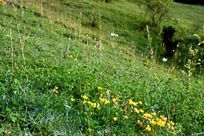
 Dry, calcareous grassland is mostly "man-made" in Britain, but much of it has been around for thousands of years. It has a rather characteristic fauna, which includes a number of introduced species that have naturalised very well. As with woods, the presence of rocks makes a difference, and where there are screes, cliffs or limestone pavements, many "woodland" or "generalist" species may occur too.
If grazing pressure is reduced, as happened on chalk downs in the south and east in the middle of the last century, the grass gets much longer, and most of the characteristic species disappear. Some can be found on drier roadside verges in calcareous districts.
Associated species
- Candidula gigaxii - Scarce; southern; an introduced species
- Candidula intersecta - Common; widespread; an introduced species
- Cernuella virgata - Common; an introduced species
- Helicella itala itala - Occasional; native; a species which seems to have suffered badly from the abandonment of traditional farming.
- Monacha cartusiana - A very rare introduced species; restricted to SE.
- Pomatias elegans - Occasional; this species requires loose, moderately deep calcareous soil. It can be found in a variety of habitats, including woodland, if the soil is not compacted.
- Pupilla muscorum - Frequent; a very typical species of short calcareous grassland. Like Helicella itala, it has become rarer as grass has got longer.
- Trochoidea elegans - A very rare introduced species; restricted to SE.
- Truncatellina callicratis - Very rare.
- Truncatellina cylindrica - Very rare.
- Vallonia costata - Common; this is a more tolerant species than V. excentrica (below), and can be found also in dry, open woodland.
- Vallonia cf. excentrica / pulchella - Common; the first of these is the form found in dry grassland; the latter tends to occur in wetter open places. There is some doubt as to whether these are two species, or just ecological variants.
- Vertigo pygmaea - Frequent.