
By Stella M. Turk
 It is said that he sold these lithographed sheets, including those on biology, for a penny each at the local Church Bazaars; certainly one (see above) was written especially for such a Bazaar.
A few of his other numerous papers were published in the Journal of the Royal Institution of Cornwall and elsewhere, but most appeared in the Report of the Royal Cornwall Polytechnic Society. Those specifically on molluscs are as follows : –
1839. Kellia rubra. Mag. Zool.Bot. 4: 54.
1850. Land slugs found in Falmouth and neighbourhood. J. roy. Instn. Cornwall 18: 28–30
1856. Slugs. Rep. R. Cornwall polyt.Soc.24: 20
Other references to molluscs are scattered amongst his several papers on the fauna of Falmouth which appeared from 1849–1854 (inclusive): 1856–1864 (inclusive): 1869, 1870 and 1877 in Rep. R. Cornwall polyt. Soc.
Cocks died in 1878, aged 87. It is not known what became of his collections. None are in the County Museum with the Royal Institution of Cornwall material. It may be that they were in the Museum of the Royal Cornwall Polytechnic Society, the complete contents of which were sold a few years after the last war when interest had dwindled to a very low ebb.
A minor but still significant figure in the history of conchology, Cocks exemplifies a type of liberal, semi-professional scholar-naturalist which dates back to the 17th century and which was to continue into the 20th century. Many of these men were clergymen or doctors and their role in the development of the natural sciences in Cornwall, typical in this one way at least of other remote counties, is discussed by Turk (1959). All but extinct today, they are representative of a time when the humanising influence of science could still be seen as a cultural phenomenon of the utmost reality.
A full account of Cocks’ life and a list of most of his published work is to be found in the second of the following three works, whilst the first contains the titles of the majority of those lithographed by himself.
REFERENCES
BOASE, G. C. & COURTNEY, W. P., 1874. Bibliotheca Cornubiensis. London.
DAVEY, F. H., 1909. William Pennington Cocks. Rep.R. Cornwall polyt. Soc. 76 N.S. (part 1): 82–91.
TURK, F. A., 1959. Natural History Studies in Cornwall. (1700–1900) J. roy. Inst. Cornwall N.S. 3: 229–279.
ACKNOWLEDGEMENTS
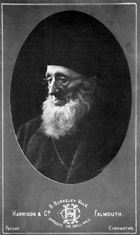
Acknowledgements are made for the use of the photograph of Dr. Cocks to the Royal Institution of Cornwall.