
Project coordinator: Jan Light
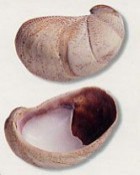 The slipper limpet is native to the Atlantic coast of North America, but some animals were introduced to Essex in 1887-90, with imported oysters, and the species has now spread along the south coast of England. It has also been found in the Bristol Channel and has been reported from Northumberland, with old records from southern Ireland, although it is doubtful whether it can form established colonies in all these places. In Europe, the species has spread from an original introduction in the Netherlands to the Kattegat and Skagerrak, and to the French Atlantic coast.
But how far have slipper limpets spread now? We need your help to find out.
The species is not difficult to identify. The animals are normally sublittoral, living to depths of 10 m, but are often thrown up on beaches after storms or may be found intertidally at LWST. They often occur in enormous numbers and are a serious pest of oyster beds.
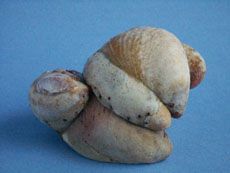 The animals usually attach themselves to one another to form chains or stacks. The individual shell has a small depressed spire and large final whorl. The aperture is large, kidney-shaped, and in the empty shell is half blocked by large shelf-like partition near spire, called a septum. There is no operculum present. The shell is up to 50mm long, 25 mm high, solid and rather glossy, and with occasional growth lines. It is yellow or red-brown, mottled with short dark streaks. Usually there is a paler band along the periphery. The internal septum is white, and the rest of the internal surface is tan.
The chains of up to fifteen animals (usually fewer) are made up of small male animals on the top, with some in the middle in the process of changing sex, and the large animals at the base of the stack being female. The males fertilize the females in the same chain. Chains persist by the addition of small males at one end while females die at the other.