
Project coordinator: David Long
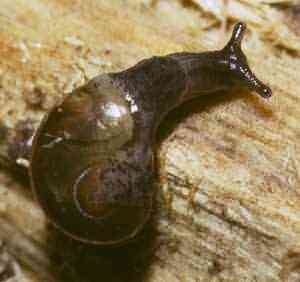
Phenacolimax major, the Greater Pellucid Glass Snail, is an uncommon semi-slug found in Britain (post-1965) in 59 10x10km grid squares in southern England and south-east Wales, with pre-1965 records in four further squares. Elsewhere, its main range is in France and west Germany. (Kerney, Atlas of the Land and Freshwater Molluscs of Britain and Ireland, 1999. p. 135). It is not known if it is in decline or holding its own in Britain; it could be as rare as the Mountain bulin (Ena montana), but it does not have any particular conservation status - should it?
In Britain, one other semi-slug, the widespread Vitrina pellucida, is associated with it. Both species are annuals, maturing, breeding and then dying off in the spring. P major is found into May and early June: rather later than V. pellucida which disappears by the end of April, or earlier. Here, P major is associated with old woods, especially with wetter places near springs, streams and flushes, whereas V. pellucida occurs in a variety of habitats - woods, vegetated stone walls, grasslands, and even gardens.
Live animals of P. major differ externally from V. pellucida in having a slightly flatter shell and a mantle edge which extends back over the shell to reach the apex; the mantle is also often blotched with black. V. pellucida has a much smaller mantle edge with a small dark mark near the mantle opening. There are also difference internally, in the reproductive system (see Kerney and Cameron A field guide to the land snails of Britain and north-west Europe, 1979, pp. 109 and 115).